The throughline of Jenna Conway’s career is a simple conviction: Real change in education starts with the people those systems are meant to serve.
It’s a lesson she learned coordinating New York City’s 9/11 response, carried through nearly 15 years leading state education agencies, and brought with her when she was appointed Virginia’s Superintendent of Public Instruction in 2026.
We sat down with Superintendent Conway to learn more about what she heard on her Commonwealth Listening Tour, how Virginia is raising the bar on accountability, and what it means to build an education system that works for every learner.
Q: Earlier this year, you toured the Commonwealth to get a better sense of what is working well and where challenges remain in education in Virginia from district leaders, educators, and families. What did you learn, and did anything surprise you?
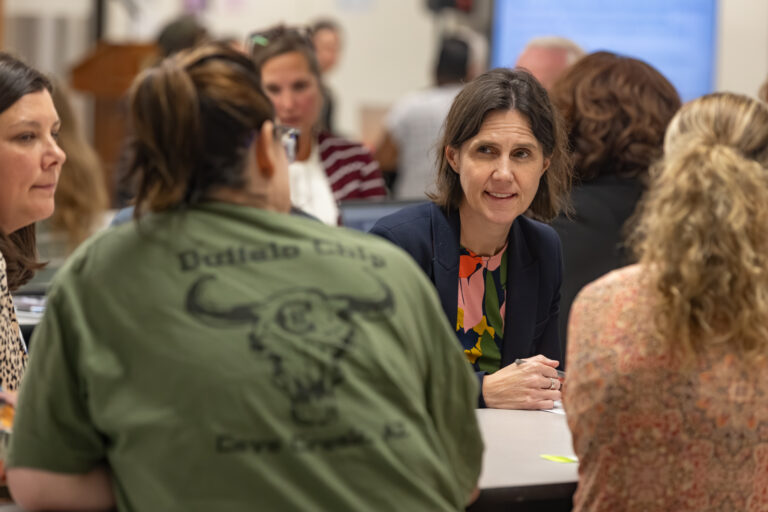
Conway: The Commonwealth Listening Tour was a powerful blend of hope and candor, and now—with the release of our comprehensive report—we’ve been able to connect firsthand stories to concrete findings. Over 2,200 educators, leaders, students, and community members provided us with feedback on what’s going well in our schools and where there is room for improvement. Across 53 hours of listening sessions and through an online survey, we gathered insights from Virginians on topics ranging from literacy and math, to assessment and accountability, to school operations.

One of the most striking themes to emerge was the depth of conversation around education technology. While public discussion often centers on cellphones, participants—including students, educators, and parents—focused more broadly on how technology is shaping teaching, learning, and student well-being. Perspectives varied, but the conversations made clear that school communities across the Commonwealth are actively grappling with how to use technology thoughtfully and effectively.
Armed with this candid feedback and the findings captured in the report, we are ready to move from listening to action. That means elevating excellence, adjusting accountability approaches, supporting the educator workforce by addressing barriers and increasing pathways, exploring deeper partnerships with divisions and providing them with wraparound supports, and smartly navigating technology integrations. The report provides a powerful blueprint for learning from our communities and taking action to build on strengths and address gaps to improve student outcomes.
Q: Many people know you as the state leader of early childhood education in two states (Virginia and Louisiana), but you had a deep background in education prior to those roles. Can you share the experiences that prepared you to lead the Commonwealth’s education agency?
Conway: My career began in New York City working inside human services agencies. There, I worked to strengthen supports for over a million low-income families in public housing and helped coordinate the city’s response to 9/11. Those early experiences taught me that real change starts with engaging the people those systems are meant to serve and it takes systems-level thinking to achieve impact at scale.
Since then, I’ve spent almost 15 years in senior leadership at state education agencies, driven by one core belief: every child deserves a high-quality learning experience every day. This means that we have to build systems that focus on every classroom and every educator, supporting them to be the best that they can be, and then a little better tomorrow. We also need to see local leaders as partners—whether superintendents, principals, or early childhood site leaders. From strengthening early childhood literacy to improving special education, I have strived to ensure state resources help local leaders be most effective; our success is tied to their success.
That commitment to excellence for every student, partnership, and continual improvement is the vision I’m bringing to the VDOE.
Q: As states and districts are grappling with challenges like budget deficits, staffing shortages, and AI integration, what do you see as the biggest opportunities? What are you excited to get to work on with teachers, principals, and superintendents?
Conway: For me, the biggest opportunity is deepening our partnerships with school divisions so we’re tackling these challenges together rather than in isolation. The leaders and educators closest to students and families know what’s working and what isn’t. I want to build partnerships between the state, educators and families where we solve problems side by side, always keeping the focus on what’s best for Virginia’s learners.
I’m also focused on strengthening our system for measuring schools: the School Performance and Support Framework (SPSF). Virginia educators have told us that they welcome the opportunity together to show where they are strong and to identify where support is needed to better serve students. And parents and community members want to know how their schools are doing. This means we need a measurement and improvement system with clearer guidance, more actionable data, and more targeted interventions tailored to each school’s context with a relentless focus on students in greatest need. When we get this right, we help give educators the tools they need to raise instructional quality and ensure every student can fulfill their potential.
Q: As state superintendent, what does “academic success” in K-12 mean to you, and where do you see the greatest opportunities for the state to raise expectations while better supporting schools and educators?
Conway: Academic success in K-12 means that Virginia students graduate with the skills, and knowledge needed to be ready for life. To do this, Virginia needs clear, connected pathways where every student is supported from their earliest years through their transition into postsecondary opportunities—with each stage setting them up for the next.
These pathways start with our birth-to-five system and VQB5, which sets high expectations in early childhood and builds strong foundations. Recent laws such as the Virginia Literacy Act reinforces this by ensuring every classroom uses high-quality instructional materials and evidence-aligned practices so every child is reading, writing and doing math on level by third grade. As our capable Virginia students move through the system, the Standards of Learning and School Performance and Support Framework set high expectations, guide continuous improvement, and keep schools focused on academic mastery and preparedness for what’s next. The final piece is postsecondary readiness—whether students pursue higher education, enter the workforce, or serve in the military. We must partner with middle and high schools to ensure every learner leaves with the skills, knowledge, and confidence to succeed in whatever path they choose.
But none of this works without strong educators and engaged families. Raising expectations has to go hand in hand with targeted support for schools, teachers, and parents. By deepening our partnerships with divisions and delivering assistance where it’s needed most, we can ensure every student has access to high-quality learning from early childhood through graduation.
Q: How do you see Virginia strengthening the connection between high school, postsecondary education, and the workforce so that more students graduate with clear, viable next steps—whether that’s college, career, military, or a mix?
We are proud of the work happening across Virginia to ensure every student is prepared for opportunities beyond graduation. In the 2024-25 school year, we launched the 3E (Enrollment, Employment, and Enlistment) Readiness Framework, a new high school readiness indicator embedded in our accountability system. Building on career exploration in middle school, 3E connects students to meaningful coursework and real-world experiences that prepare them for sustainable postsecondary pathways. By focusing on concrete outcomes and stronger transitions beyond high school, the framework helps ensure every student graduates ready for life.
We are committed to continuously improving 3E so every learner can graduate prepared for enrollment, employment, or enlistment, and is confident in their next step. This includes opportunities such as work-based learning placements and industry‑recognized credentialing—experiences that help students understand workplace expectations and build practical skills.
Q: Employers across the Commonwealth (and the country) are calling for stronger preparation in areas like early literacy, advanced math, and durable skills. What role should the K-12 system play in preparing students for Virginia’s workforce needs, and how can the state better align education policy with long-term economic goals?
Conway: Together, early childhood care and education and K-12 education form the foundation of Virginia’s future workforce. In early childhood, we are expanding access to high-quality birth-to-five care and education while improving teacher-child interactions in 12,000 classrooms. Through our nation-leading statewide literacy screener, we are identifying student needs earlier and supporting stronger literacy development by using the science of reading in every K-5 classroom and strengthening interventions for middle school students. We are opening access to algebra and geometry to more middle school students as well as access to college-level courses for high school students, enabling them to earn associate degrees before they graduate.
Alongside those fundamentals, students are building durable skills such as communication, critical thinking, and collaboration. These are the skills that hold their value whether students pursue enrollment, employment, or enlistment.
Strong preparation also requires alignment between education policy and economic reality, even as society changes at lightning-fast pace. That means using labor market data to inform planning, expanding CTE and work-based learning in response to industry trends, modernizing credentialing and increasing internship and apprenticeship pathways in high-demand fields. Career exploration shouldn’t wait until high school—students at every grade level should have opportunities to identify their strengths early and explore real-world opportunities.
When rigorous academics, durable skills, and practical experience work together, students leave better prepared, employers gain a stronger talent pipeline, and Virginia is better positioned to thrive.