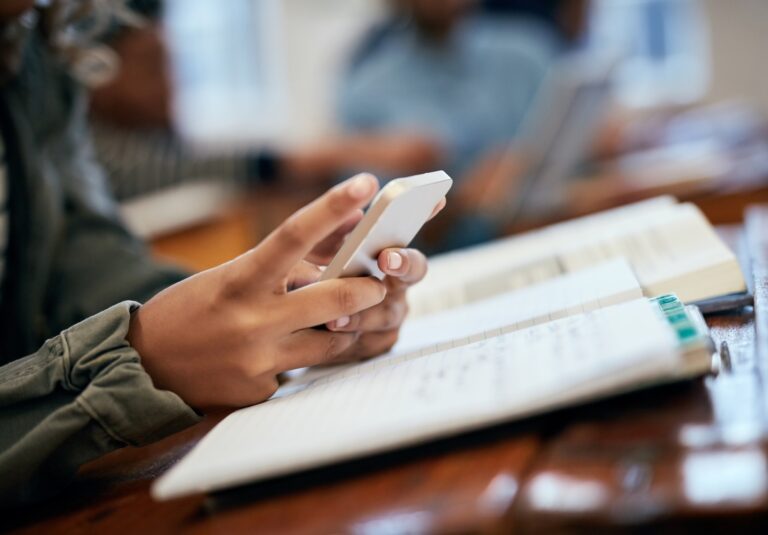
This week, the National Bureau of Economic Research (NBER) published the largest and most comprehensive study of school cellphone bans to date—with mixed results.
The study, led by researchers at Stanford, Duke, the University of Michigan, and the University of Pennsylvania, analysed data from approximately 4,600 schools in the U.S. using Yondr, a lockable pouch designed to prevent cellphone use in restricted settings.
Key Findings
- Do cellphone bans reduce in-school phone use? Yes. In schools with bell-to-bell bans, the share of students using cellphones in class for non-academic purposes dropped from 61% to just 13%. Teachers also reported that students were less distracted.
- Do cellphone bans boost academic outcomes? Minimally, if at all. Average impacts on standardized test scores were “consistently close to zero” across the first three years after adoption. Findings were similar across the course subjects studied.
- Do cellphone bans improve student behavior? More of a mixed bag. Suspension rates (both in- and out-of-school) increased roughly 16% in the first year of adoption, likely due to strict enforcement and a shift to other disruptive behaviors. Student well-being also declined slightly. However, the negative effects were temporary: By year three, suspension rates normalized, and student well-being rebounded by year two.
Stanford economist and co-leader of the study, Thomas Dee, called the results “sobering,” but cautioned policymakers and education leaders against abandoning the policies before they have the opportunity to work. [NBC News; The 74; The New York Times, subscription model]
“We need to not succumb to the usual faddishness that permeates education reform, and persist with a robust learning agenda that will allow us to figure out how to manage digital devices and support child development,” said Dee.
Why it Matters
The findings stand in contrast to several years of tremendous policy momentum—at least 39 states have passed legislation restricting cellphone use in schools since 2023—but they also raise a harder question: What are bans alone actually accomplishing?
A white paper released earlier this year by Learning.com and Whiteboard Advisors argued that while device restrictions can reduce distractions during school hours, they don’t necessarily equip students with the skills to manage attention, social pressure, or algorithm-driven content outside of the classroom.
According to Julia Fallon, executive director of SETDA, 3 out of 4 state education leaders have adopted device restrictions or are considering them, but only 60% reported that their state is actively supporting digital citizenship education for students. “A cellphone policy can reclaim attention during the hours students are in school, but it cannot do the rest of the work on its own,” said Fallon.
Learning.com CEO Lisa O’Masta addresses the challenge: “Bans can’t be the end. They have to be the beginning of the conversation. When you do finally get your phone back in your hands, how are you going to react to it?”
This article is sourced from Whiteboard Notes, our weekly newsletter of the latest education policy and industry news read by thousands of education leaders, investors, grantmakers, and entrepreneurs. Subscribe here.