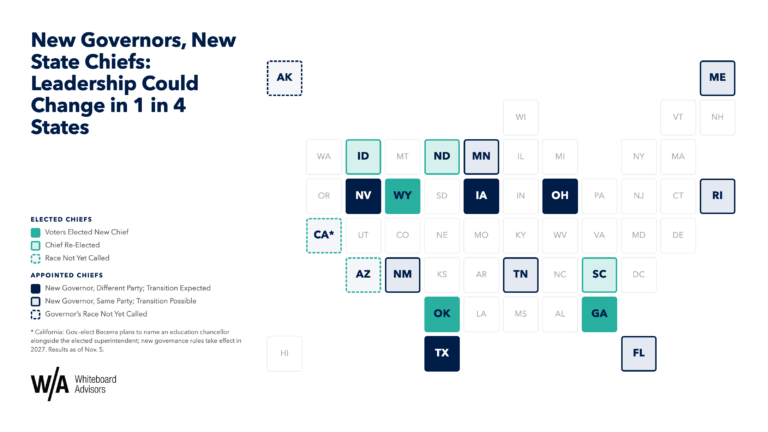
Changing statehouses often means new state education leaders. 19 states have their state education leader appointed by the governor and 12 more have their top official elected by the populace; others are appointed by a state board of education.
Based on this week’s election results, up to 16 states could see new leadership setting policy, guidance, and implementation support across K-12 systems by January. We’ll be tracking priorities and positions ahead of the 2027 legislative session, and in anticipation of governors’ State of the State addresses.
Where to Look for New State Chiefs
On November 3, 2026, voters selected new state education chiefs directly, with five more state chief roles to be appointed by newly elected governors. We are also following six additional state chief positions where the governorship did not change parties, but may still be looking for new education leaders.
Below is a breakdown of these races and the significance a new state chief brings to each state. Check out more on the W/A Research site.
Newly Elected Chiefs
- Georgia: Democrat Lydia Powell defeated three-term Republican incumbent Richard Woods for state superintendent. Governor-elect Lance-Bottoms campaigned on fully funding Georgia Pre-K and raising teacher pay. Superintendent-elect Powell is also likely to seek rural recruitment incentives and more funding for high-poverty schools.
- Oklahoma: Republican Robert Franklin won the seat that Lindel Fields has served in since Ryan Walters resigned last year, over Democrat Jennettie Marshall. Superintendent-elect Franklin takes over implementation of the Strong Readers Act, whose strict third-grade retention requirement takes effect in 2027-28.
- Wyoming: Republican Steve Harshman won the open seat over Democrat Ana Cordova. Harshman, a former state House speaker, campaigned on local control, criticizing the state’s new school funding law’s “silo” model, which limits money for teachers and aides to instructional spending.
- Arizona (not called): Democrat Teresa Ruiz leads 53% to 47% over Republican Kimberly Yee with roughly 80% of the expected vote in. Whoever wins will oversee a state with one of the largest universal ESA programs.
- California (not called): Richard Barrera leads Sonja Shaw, 57.1% to 42.9%, with about 60% reporting. California, however, is entering a unique transition with new rules for 2027.
- Also of note: Three states re-elected their current state chiefs. Idaho’s Debbie Critchfield won a second term, South Carolina’s Ellen Weaver won a second term, and North Dakota’s Levi Bachmeier won his seat.
Newly Appointed Chiefs
In these states, the newly elected governor has direct authority to appoint or approve the chief.
- Texas: Governor-elect Hinojosa (D) will appoint a new chief, having said during her victory speech, “On Day 1, I will fire Mike Morath.” [KVUE]
- Iowa: Governor-elect Sand (D) is all but certain to name a new chief to succeed McKenzie Snow, appointed by the current (R) administration.
- Ohio: Governor-elect Acton (D) is all but certain to name a new chief to succeed Stephen Dackin from the current (R) administration.
- Nevada: Governor-elect Ford (D) may replace Victor Wakefield from the current (R) administration. It is of note that Nevada’s previous chief spanned Democrat and Republican administrations before leaving to take the role of Clark County Superintendent.
- Alaska: Deena Bishop is governor-approved, and the governor’s race is still being counted.
Other Possible Transitions
A change in the governor’s office can mean new leadership at the state education agency even when the party stays the same. We are monitoring potential changes to the state education offices in Maine, Minnesota, New Mexico, Tennessee, Florida, and Rhode Island. We may also see changes in states where state boards appoint the chief, but those will take longer to develop, whereas governors tend to want the position filled by “their pick” on Day 1 in January.
What We’re Watching
- The nominees. Who gets short-listed for the likely open roles in Texas, Iowa, and Ohio.
- The uncertainties. How unresolved races in Arizona and California, and the governor’s race in Alaska may change the overall picture.
- Continuity of priorities. Many state chiefs have spent the past four years or more on early literacy, school choice programs, assessment innovation, and postsecondary pathways. New leadership may keep, rebrand, or deprioritize those efforts.