We’ve worked together for 21 years, across five presidential administrations and more statehouses than we can count. People often ask whether our firm is nonpartisan. The answer is no: We’re partisan—but on both sides. In fact, our team is expected to disagree (respectfully) in the room, so that our clients aren’t surprised outside of it.
Mornings like this one are why.
Beyond the federal elections that always dominate national headlines, Democrats flipped five governorships (Georgia, Iowa, Nevada, Ohio, Texas), but they also broke four Republican trifectas. Democrats also took the Wisconsin Senate, won a trifecta in Pennsylvania, and broke the Republican supermajority in Florida.
Georgia elected a Democratic state school superintendent for the first time since the 1990s. The conservative North Carolina House turned blue. In Texas, Democrats also won comptroller, the office that runs the state’s new education savings accounts. Further down-ballot, in places like Cobb County (Georgia’s second largest district), local school boards also flipped which could lead to district superintendent transitions. Cobb won’t be the only board to change hands, either.
For the next 72 hours, Whiteboard Advisors is opening its election analysis to everyone.
W/A Research membership covers our live K-12 policy tracker, issue reports, and analyst support. Contact our team for details.
What we’re watching:
School Choice
Four of the five flipped states have existing programs: Georgia’s Promise Scholarship, Iowa’s ESAs, Ohio’s EdChoice, and Texas’ new accounts. Some of the winners campaigned against them. Programs with families enrolled are hard to unwind, so expect fights over funding, eligibility, and oversight rather than repeal. School choice in Florida, under Republican Governor-elect Donalds, will continue to expand.
The federal scholarship tax credit is an open question, but not just because of what will happen at the federal level. New governors have to decide whether to opt in (or stay in, in places like Colorado), while congressional Democrats push repeal and the president holds the veto.
State Chiefs
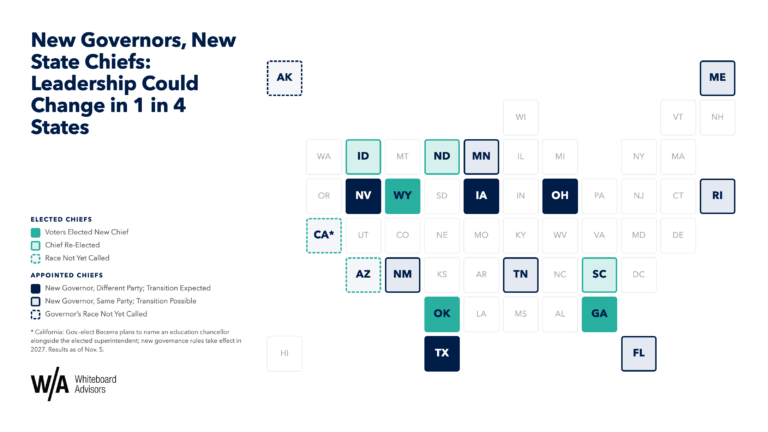
Georgia and Oklahoma elected new superintendents; Arizona and California superintendent elections have yet to be called as of noon Wednesday. Three Republican incumbents held their seats: South Carolina’s Ellen Weaver, Idaho’s Debbie Critchfield and North Dakota’s Levi Bachmeier. New Democratic governors in Texas, Ohio, and Iowa will most certainly appoint new chiefs; it’s too soon to know what will happen in Nevada. All in, there are loads of state chiefs sitting in states that elected governors (or state board members) who didn’t pick them. Change is coming.
AI and Edtech
This issue doesn’t follow party lines. The states that passed classroom screen-time laws this year were red (Utah, Alabama, Tennessee); the big districts that paused AI or capped screens were blue (New York, Los Angeles); and, in August, the U.S. Department of Education told states to judge classroom technology by what students learn, not by minutes on a screen.
Half the candidates for Chicago’s new board, including the president-elect, Jessica Biggs, signed a pledge for a three-year pause on generative AI and no screens before third grade.
With a divided government now in Georgia, Iowa, Ohio, and Texas, the bills that move in 2027 will be bipartisan ones, and guardrails on screens and AI are exactly that. Expect the question to shift from whether a tool uses AI to whether it works, for which students, and at what dose.
School Boards
Some of the best news of the night for anyone who cares about how districts are run came from Chicago, which elected the president of its first fully elected board. Jessica Biggs, a former special education teacher and CPS principal, took nearly half the vote in a three-way race, roughly 18 points ahead of the Chicago Teachers Union’s candidate, with a coalition that ran from SEIU and the Chicago Federation of Labor to the business community and more than 20 alderpeople.
Nearly $14 million flowed into Chicago’s board races, most of it aimed at a seat that pays nothing. She ran on stability, the budget, and rebuilding trust with families. If you don’t know much about Biggs, take the time to learn more. Expect a kid-centric approach that could prove a bellwether for district policy on edtech.
What Happens at the Federal Level
Oversight, not legislation. Expect hearings on how the U.S. Department of Education was taken apart and where its programs went, appropriations riders, and a run at repealing the tax credit. The president keeps the veto and the rulemaking pen. Rick Hess called it this morning: “Oversight, with a vengeance.”
None of this is new to us. We’ve watched choice programs outlast Democratic governors and teacher raises outlast Republican ones. The policies that survive are the ones backed by constituencies, not just sponsors.
That is the case for being partisan on both sides: You know where the constituencies are, and you can still pick up the phone the morning after.