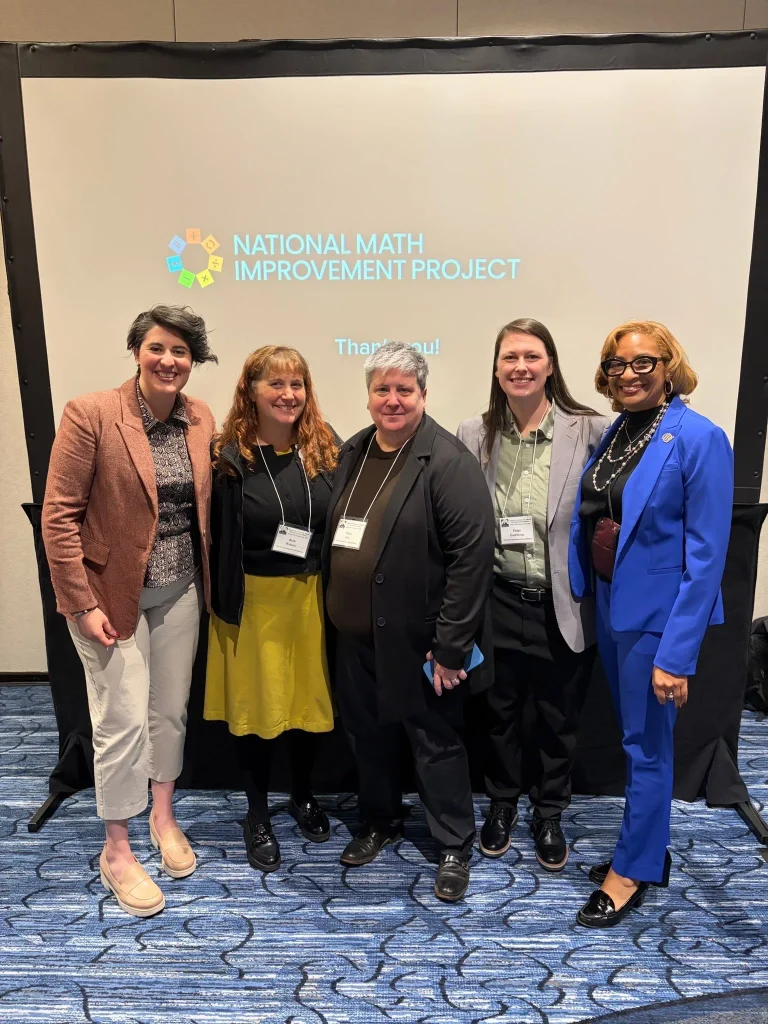
Over the past two weeks, leaders from the six National Math Improvement Project (NMIP) districts shared their work with peers at the Council of the Great City Schools Fall Conference in Boston and the NCSM Annual Conference in Denver. The sessions were standing room only. The questions from district leaders, partners, and researchers were specific and practical: how to schedule acceleration without tracking students out of it, how to tell whether implementation is working, and how to build enough math expertise among adults to sustain the work.
Those questions reflect where many large districts are right now. Most have adopted high-quality instructional materials (HQIM). The harder work is making materials, schedules, professional learning, and supports for students function as one system and at scale.
Math has become an increasingly important priority across states. In September, California became the latest state to act, with a new law requiring schools to screen K-2 students annually for math difficulties and provide added supports. According to an Education Week tracker, 22 other states have passed laws or implemented new policies on math education since 2022, and 14 states now require early math screening paired with intervention. State boards are also making moves, as NASBE analysis found that 20 state strategic plans now include numeracy goals.
These policies set requirements or minimum expectations for diagnostic screening, intervention, instructional materials, and access to advanced coursework. States do not typically specify how a district serving hundreds of thousands of students should redesign its schedule, train its coaches, or decide which students complete Algebra I in eighth grade. That work happens in districts, and implementation at scale is the focus of the National Math Improvement Project, a community of practice formed in 2022 whose six districts serve 2.3 million students.
District teams presented on a range of topics related to math strategy and implementation. Three threads stood out:
- Accelerated middle school math, designed for access and success. Chicago Public Schools is piloting a compacted middle grades course that covers all sixth- through eighth-grade standards in two years by going deeper, not faster. The district has 31 schools in a professional learning cohort, and its first pilot group is now taking Algebra I in eighth grade. Los Angeles Unified is building pathways with flexible entry points, including summer, plus a dashboard that identifies eligible students as early as fifth grade. The School District of Philadelphia has launched an accelerated sixth-grade cohort and an Algebra 1a cohort as part of its focus on Algebra access for all.
- Professional learning that builds math content knowledge. Houston ISD runs recurring “Content Intensives” that help teachers understand upcoming content, anticipate student misconceptions, and practice key instructional moves before they teach. New York City Public Schools moved all math professional learning to in-person formats. The approach pairs content learning in year one with job-embedded pedagogical support and ongoing community, and it shifts from individual coaching toward collective work across schools.
- Fluency that goes beyond K-5. Leaders described numeracy as a K-12 priority and defines “fluency” as accuracy, flexibility, and efficiency. The aim is not to drill. It is automaticity that frees up working memory so students can take on more complex problems. In Chicago, professional learning on fluency has focused on moving from rote memorization to strategies, often through games and family engagement. Houston builds a short fluency routine into every math lesson and treats K-2 number sense as groundwork for Algebra 1. One example connected composing the number seven in kindergarten to factoring a quadratic.
Go Deeper
- NMIP districts’ conference presentations.
- Mathematical Fluency: A Practical Primer, featuring Dr. Jenny Bay-Williams.
- “Breaking the Cycle of Math Anxiety,” a podcast featuring W/A’s Hillary Rinaldi.
This article is sourced from Whiteboard Notes, our weekly newsletter of the latest education policy and industry news read by thousands of education leaders, investors, grantmakers, and entrepreneurs. Subscribe here.