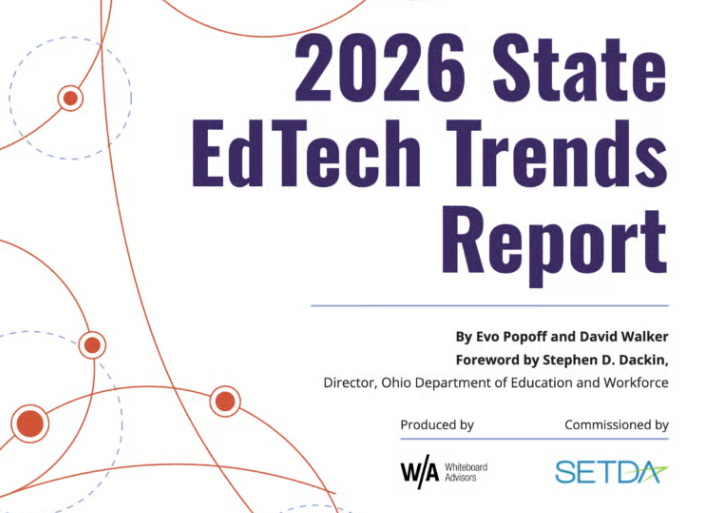
Today, the State Educational Technology Directors Association (SETDA) released its fifth-annual State EdTech Trends Report. The report, developed in collaboration with Whiteboard Advisors, explores how state education leaders are responding to a growing national conversation about technology in schools while AI keeps moving to the center of their work.
The findings show states taking on more responsibility for how technology is used in classrooms, from AI policy to cellphone bans to what schools buy, often with small teams and limited budgets. 74% of respondents say their state lacks a dedicated, sufficient edtech budget, and 76% have five or fewer staff working on edtech.
Key Findings
- AI stays on top, and states are writing rules: 79% of state leaders named AI a top technology priority, up from 68% last year, and 83% of states now have an AI initiative. States are also moving from guidance to formal policy. Ohio now requires every district to adopt an AI policy, and 23% of respondents say state law requires AI guidance, up from 4% in 2024.
- Skepticism about edtech is growing, but data is lagging: 67% of respondents say their state has a lot of edtech but doesn’t always use it effectively, up from 56% last year. Yet 52% say their state collects no data on whether edtech tools are used or working.
- Cellphone bans become the norm: 57% of respondents report a strict statewide ban, up from 22% in 2025. Many are pairing bans with support for responsible use, and 76% support digital citizenship education.
- States are raising the bar on purchasing, particularly around evidence: 53% of states have published guidance on buying AI-enabled tools, and 79% of that guidance now includes evidence standards, up from 45% last year. Still, 68% say vendor claims about AI products are hard to verify.
- Professional learning is the fastest-growing gap: 62% named professional learning a top unmet need, up from 47% last year. States like North Carolina are using regional consultants and summer events to bring training closer to educators.
The debate over classroom technology isn’t going away any time soon. Increasingly, the question for state leaders is whether the technology in schools is safe, effective, and worth the investment. As Stephen Dackin, director of the Ohio Department of Education and Workforce, writes in the report’s preface, “Our answer should not be to reject technology, and it should not be to adopt it without question.”
This article is sourced from Whiteboard Notes, our weekly newsletter of the latest education policy and industry news read by thousands of education leaders, investors, grantmakers, and entrepreneurs. Subscribe here.