
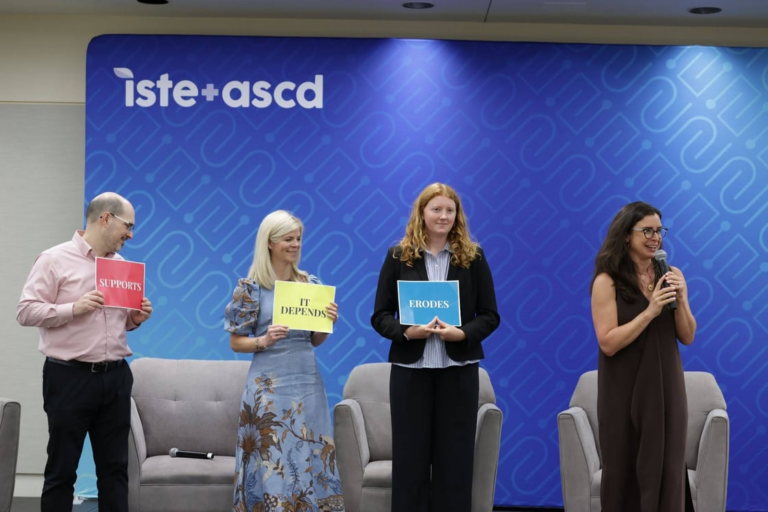
The biggest week on the K-12 edtech calendar just wrapped in Orlando, and a large contingent of the W/A team was on the ground for it—moderating panels; running a media room that hosted dozens of reporters, bloggers, and creators from around the world; and co-hosting the Solutions Summit with ISTE for the third straight year.
The headline came off the mainstage: ISTE+ASCD is changing its name. The ISTE acronym survives, but it now stands for the International Society for Transforming Education. CEO Richard Culatta framed the change as a move from what the two legacy organizations did to why they do it, reaching for the Roger Bannister four-minute-mile story to argue that the barriers around assessment, student ownership, and belonging are more perceived than real.
The product news backed up the framing. ISTE shipped Stretch, the educator chatbot it has spent three years building and rebuilding. We first saw it demoed at ISTELive23 in Philadelphia. This version runs only on vetted ISTE and ASCD materials—no stray cookie recipes—and now includes a wellness coach for teachers running on empty. “Building AI apps is not easy,” ISTE’s Joseph South said, and three years of re-engineering make the case for him.
The organization also expanded its Profile of an AI-Ready Graduate, now 30 skills across six roles students play when working with AI, and announced a “safe and purposeful” technology-use pledge with GreatSchools.org: five recommendations and a tiered badge schools can show parents. Culatta’s advice to districts was to start by admitting where the work is, including tech policies written by lawyers in language no kid could follow.
Pull on any of those threads and you reach the same place. In 2017, my first ISTE, the talk was Chromebooks, 1:1 rollouts, and the homework gap, and the divide that mattered was who had a device. This year, the divide leaders worried about was who knows how to question what the tools produce. Teaching AI, as Culatta put it, “as a way to support us being better at being human” is a different assignment than teaching what AI is.
That shift showed up in the sessions our colleagues led. I moderated a panel on trusting AI in schools and kept landing on the same point: the technology earns its place only if it deepens the relationship between a school and the students and families it serves. Carlos Zavala got there from another direction on his panel on technology and relationships—chronic absenteeism doesn’t yield to harder tracking so much as to trust. The numbers back that up. National chronic absenteeism sat at 22.6% last year, barely down, and the districts moving the figure, like Detroit with its family health hubs and home visits, are the ones treating attendance as a relationship problem rather than a compliance one. [SmartBrief; Education Week, subscription model; EdSurge; Government Technology; Chalkbeat]
This article is sourced from Whiteboard Notes, our weekly newsletter of the latest education policy and industry news read by thousands of education leaders, investors, grantmakers, and entrepreneurs. Subscribe here.