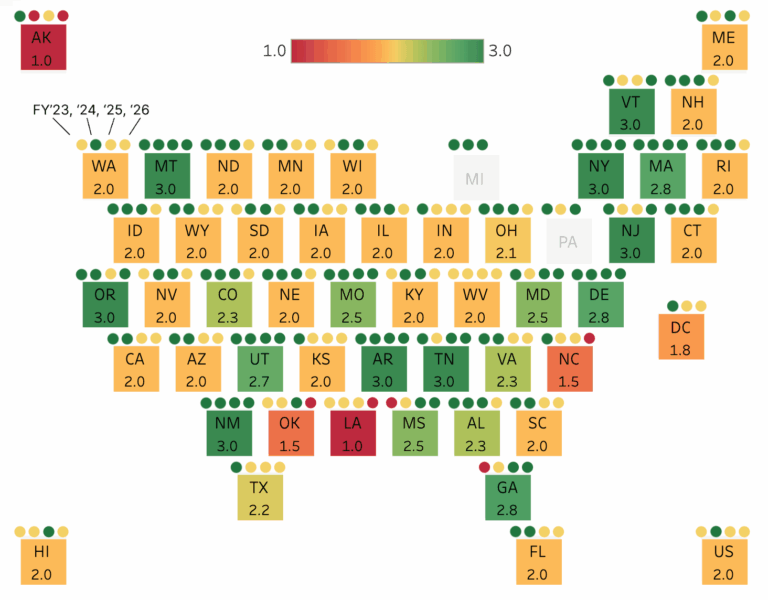
The map shows whether state education budgets are down (red), level (yellow), or green (up) over the prior year. Budget trends are scored 1 to 3. “1” is declining. “3” is improving.” “2” is level or marginal changes that may be washed out by rising costs. Scores are fractional because there are various parts of K-12 funding with scores.
With all but two states left to finalize FY26 budgets, the budget picture is coming into focus. Most legislatures opted for level funding, or modest increases. Several paired new investments to targeted strategies to bets on preschool, high school reform, school choice, and digital literacy.
Here’s what we’re watching:
Arizona: Funding 9th Grade Success
Arizona lawmakers approved $3.4 million for a new initiative aimed at increasing the number of 9th grade students on track to graduate, an evidence-backed indicator strongly correlated with high school completion. The program, supported by the Center for High School Success, provides grants to schools to implement early warning systems, advisory periods, and staffing supports [KTAR]
Colorado: Preschool and Rural Teacher Recruitment
Colorado’s education budget reflects an ongoing commitment to expanding universal preschool while addressing persistent workforce challenges. It adds $6 million to keep preschool free for every 4-year-old, directs $12.6 million to expand Early Intervention services for babies and toddlers with disabilities, and continues a $2.9 million pilot to raise wages for child care workers statewide [Chalkbeat Colorado]
Connecticut: Early Learning and Dual Enrollment
Connecticut’s education budget expands early childhood access and affordability and also seeks to boost college readiness. It allocates $300 million to a child care fund projected to add 16,000 affordable slots by the early 2030s and establishes a $36 million Early Childhood Endowment to offer free child care, renovate facilities, and raise child care workers’ wages. The state will also provide $6 million to offset costs associated with dual enrollment starting in FY27. [CT Insider]
Montana: Education Workforce and Readiness Investments
Montana enacted the STARS (Strategic Teacher and Rural Student) Act, a statewide initiative to strengthen both the educator pipeline and student career readiness. The law dedicates $100 million to raise starting teacher salaries, adding incentives for district resource sharing, expanded CTE opportunities, and new “Future Ready” pathways that help students prepare for postgraduation careers or college [Montana Free Press]
New Mexico: Funding Boosts Learning, Early Childhood, and Safety
New Mexico continues to lead in per-pupil funding growth, with major investments in career and technical education, secondary school reform, and special education. The budget doubles early childhood funding to $500 million and directs additional resources toward student safety and wellness, including support for unhoused students, wellness rooms, and school panic buttons.
Nevada: Weighted, Outcomes-Based Funding
Nevada passed a $12.9 billion education budget that keeps last year’s $250 million in teacher raises and, for the first time, guarantees equal pay for charter school teachers. The plan adds $5,000 bonuses for hard-to-fill jobs in low-income and special education schools, while continuing the Pupil-Centered Funding Plan with equity-weighted allocations, outcome-driven funding pilots, and early warning systems that echo Arizona’s 9th grade success strategy. [Reno Gazette Journal]
Ohio: Literacy and Direct Admissions
Ohio’s budget bill includes both funding and legislative changes with long-term implications. FY26 funding supports continued implementation of the science of reading, including teacher training and instructional materials. Lawmakers also launched a new direct admissions program that guarantees spots at participating public colleges and universities for high school students graduating in the top 10% of their class.
Texas: School Choice Expansion and Special Education Reform
Texas lawmakers approved an $8.5 billion public school funding plan paired with $1 billion for a new statewide education savings account (ESA) program. The program provides $10,500 per student and up to $30,000 for students with disabilities. The budget also overhauls the special education funding formula and adds $1,000 per disability evaluation. [The Texas Tribune]
West Virginia: Voucher Growth and Digital Literacy Investment
West Virginia’s budget expands the Hope Scholarship voucher program to universal eligibility through increased funding, raising the number of full-scholarship recipients from just over 10,000 last year to an expected 15,000. The state also continues to invest in the Mountain State Digital Literacy Program. [West Virginia Metro News]
This article is sourced from Whiteboard Notes, our weekly newsletter of the latest education policy and industry news read by thousands of education leaders, investors, grantmakers, and entrepreneurs. Subscribe here.