
The Education Department’s Reimagining and Improving Student Education (RISE) committee concluded its negotiated rulemaking session this week, having reached consensus on the full package of federal student loan-related changes outlined in the One Big Beautiful Bill Act (OBBBA). The proposed rules, if implemented, would reshape how students and families finance higher education.
This is the first of two negotiated rulemaking committees ED is convening to set the rules for the OBBBA, with the second, the Accountability in Higher Education and Access through Demand-driven Workforce Pell Committee (AHEAD), which will set the highly anticipated regulation around Workforce Pell, set to meet December 8-12 and January 5-9.
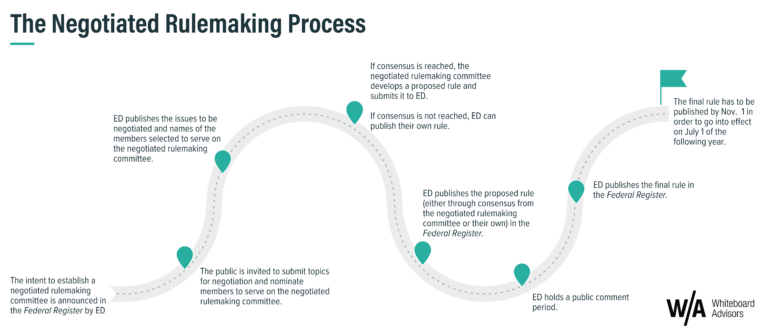
A quick refresher: Negotiated rulemaking (AKA “neg reg”) is a process many federal agencies use to develop new regulations that determine how federal law is implemented and how compliance with law is assessed. Read more on our blog.
What’s at Stake
The RISE committee reviewed and agreed upon 17 regulatory provisions included in the OBBBA that aim to reduce student loan debt and simplify pathways to repayment for borrowers. This includes measures like eliminating the Grad PLUS program, capping Parent PLUS loans, and consolidating the various existing repayment plans into one Repayment Assistance Plan (RAP).
The RISE committee also crafted regulations related to the loan changes within OBBBA, which also include setting annual student loan limits for new borrowers at $20,500 for graduate students and $50,000 for professional students, with aggregate limits of $100,000 and $200,000, respectively. These rule changes would end a 20-year rule that allowed graduate students to borrow up to the cost of attendance on an unlimited basis.
The RISE committee also came to consensus on an extremely narrow definition for professional students, limited to those in degree programs like medicine, law, dentistry, clinical psychology, theology, and other academically similar programs. This definition is more expansive than the Department’s initial proposal, which only classed 10 degree programs as professional, but less encompassing than alternatives suggested by negotiators. [Inside Higher Ed]
What’s Next
In the coming weeks, ED will publish a Notice of Proposed Rulemaking (NPRM) in the Federal Register. Because the committee reached “consensus” on ED’s draft regulatory changes, the Department is largely bound to publish the rules as agreed to by the committee, barring minor technical changes found during an executive branch review process. Upon its publication, the proposed rules will be subject to a 30-day public comment period.
Typically, regulatory changes made to Title IV programs must be published as a final rule in the Federal Register by November 1 in a given year for them to go into effect July of the following year. However, given the specific implementation dates specified in the text of OBBBA, ED’s press release suggests that the agency expects these rules to go into effect in July 2026 to align with congressional intent.
Go deeper: Please reach out to our team with any questions.
This article is sourced from Whiteboard Notes, our weekly newsletter of the latest education policy and industry news read by thousands of education leaders, investors, grantmakers, and entrepreneurs. Subscribe here.