On September 10, the House Appropriations Committee and the Subcommittee on Labor, Health and Human Services, Education, and Related Agencies held a marathon full committee markup of the FY2026 appropriations bill, running from late morning until after midnight. Members debated dozens of amendments before advancing the legislation on a 35–28 party-line vote.
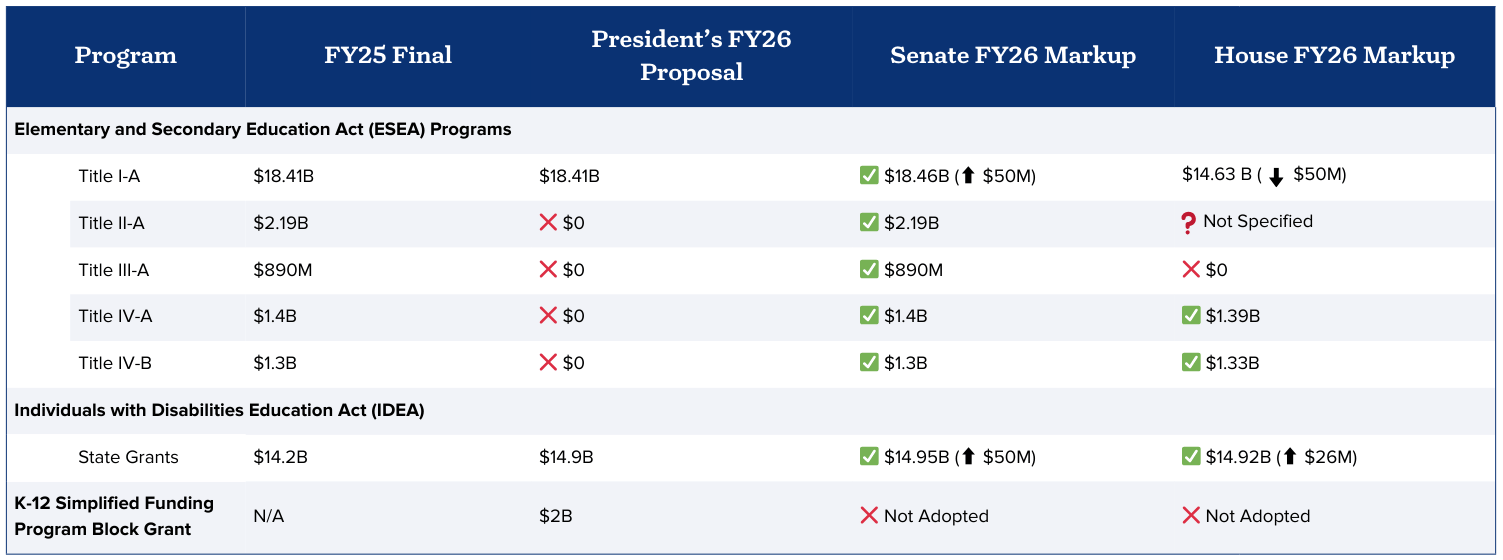
How does the House markup stack up to the Senate’s proposal?
The Senate Appropriations Committee advanced its FY 2026 Labor, Health and Human Services, Education, and Related Agencies (LHHS) funding bill, rejecting many of the steep education cuts proposed in the President’s budget request.
Markup Highlights: What’s In, and What’s Out
✅ Hispanic-Serving Institutions (HSIs) and GEAR UP: Henry Cuellar’s (D-TX) amendment to continue funding for Hispanic-Serving Institutions (HSIs) and the GEAR UP program was approved by voice vote.
✅ Medical Education: Susie Lee’s (D-NV) amendment to extend continuing medical education for rural and community providers was approved by voice vote.
✅ Active Shooter Drills: Marie Gluesenkamp Perez’ (D-WA) amendment prohibiting the use of funding for student-involved drills without an opt-out was approved by voice vote.
✅ Job Corps: Lauren Underwood’s (D-IL) amendment to protect Job Corps centers from closure was approved by voice vote.
❌ Full Service Community Schools: Susie Lee’s (D-NV) amendment to maintain current funding levels for the Full Service Community Schools Grant Program was defeated on a roll call vote, 28–34.
❌ Childhood Vaccines: Rosa DeLauro’s (D-CT) amendment to expand access to childhood vaccines was defeated on a roll call vote, 27–33.
❌ Formula Grants: Mike Levin’s (D-CA) amendment requiring the Department of Education to award formula grant funding as soon as funds become available was defeated on a roll call vote, 28–34.
❌ Adult Education and Job Training: Frank Mrvan’s (D-IN) amendment to restore funding for Adult Education programs and Adult and Youth Job Training programs was defeated by voice vote.
What’s Next
The bill will now move to the House floor for debate and amendment. Even if it passes the House, the measure differs significantly from the Senate’s version and will require reconciliation. If the two chambers cannot reach agreement, lawmakers may rely on a continuing resolution (CR) to keep agencies funded beyond the September 30 fiscal year deadline.
This article is sourced from Whiteboard Notes, our weekly newsletter of the latest education policy and industry news read by thousands of education leaders, investors, grantmakers, and entrepreneurs. Subscribe here.