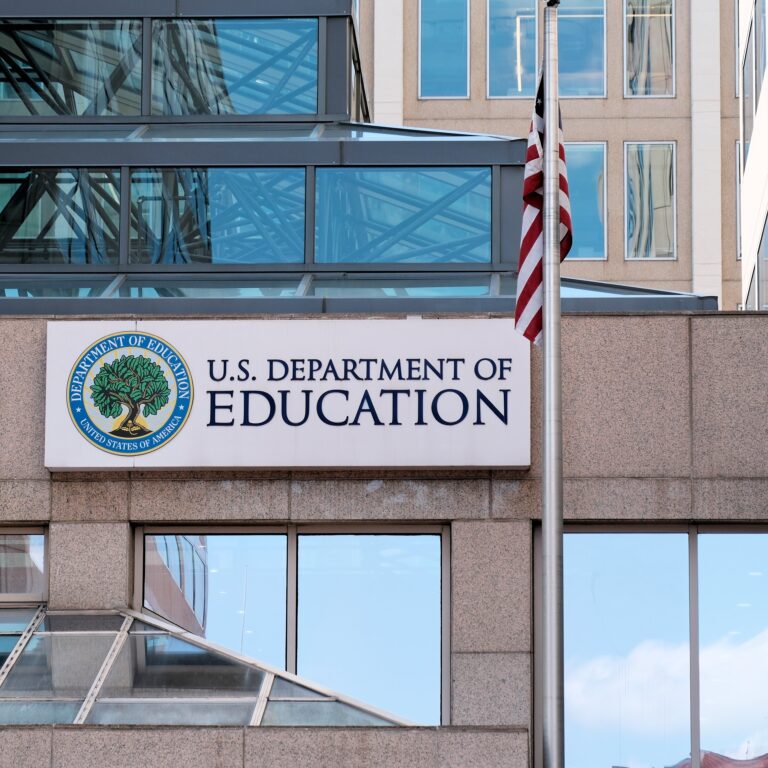
This week, the U.S. Department of Education’s (ED) Accreditation, Innovation, and Modernization (AIM) negotiated rulemaking committee reached consensus on what is arguably the most contentious rulemaking yet in this Trump administration.
Notably: The AIM regulations are the first set of rules to move forward in the Trump administration that are not associated with the statutory changes made by Congress through the One Big Beautiful Bill Act. (The One Big Beautiful Bill Act included provisions that catalyzed the recently finalized RISE regulations and Workforce Pell rules, along with the proposed AHEAD institutional accountability regulations.)
What’s in the Proposed Regulations?
The consensus draft of the accreditation regulations carries many of the priorities highlighted in President Trump’s April 2025 executive order on accreditation, including new regulatory provisions designed to limit “unlawful preferences” at institutions for students, staff, or contractors based on “race, color, national origin, or sex, including in admissions, hiring, and the selection of contracts.”
Mirroring the executive order, the proposed regulations would also require accrediting agencies to evaluate whether institutions have a policy “designed to support, promote, and appropriately prioritize intellectual diversity and the free exchange of ideas amongst faculty.” The proposed regulations would also shorten the timeline to recognition for new accreditors and are intended to create more competition among existing accreditors.
Additionally, the committee reached consensus on proposed regulations that could have significant impacts on both accreditors and the institutions that must now align with the new standards. These include:
- Improving college transfer: The AIM Committee aimed to solve common college transfer and credit articulation challenges in higher education. The proposed regulations would require institutions to maintain policies that presume that undergraduate credit will be awarded for courses successfully completed at another accredited institution, and if that credit isn’t accepted, institutions are responsible for documenting why.
- Eliminating conflicts of interest: Throughout the negotiations, the Trump administration has maintained that relationships between accreditors and trade associations relevant to the institutions they accredit can lead to credential inflation and monopolies over professional licensure standards. The proposed regulations include new provisions that would prevent officers, directors, or employees of institutions from participating in the final decision making on accreditation standards that affect their institutions. The proposed regulations would also require accreditors to have “sufficient controls” to ensure that they do not solicit feedback on agency policies or decisions from any “related, associated, or affiliated trade association or professional association.”
- Focusing on learner outcomes and institutional sustainability: The proposed regulations emphasize student outcomes, including retention, college completion, and workforce outcomes. Additionally, the proposed rules would require accreditors to institute new cost/benefit reviews of institutions which would include a review of the institution’s budget, resource utilization and allocation, and its business/strategic plan, and other documents to determine whether the expected benefits of the institution’s activities justify the associated financial and administrative costs.
What’s Next
ED will now send the draft regulations to the U.S. Office of Information and Regulatory Affairs (OIRA) for review. Once OIRA completes its review, ED will publish the draft regulations as a notice of proposed rulemaking (NPRM) in the Federal Register for a public comment period of not less than 30 days.
Since the AIM Committee reached consensus on the draft regulations, ED will publish the draft regulations largely as agreed to by the AIM committee (barring any contradictions with existing law that OIRA finds in its review and minor technical changes). In the three recent sets of rules ED has crafted, it has taken roughly 12 to 15 weeks for ED to publish a NRPM after the committee reached consensus.
After the public comment period, ED will review public comments and can make any further changes to the regulations as it sees fit based on received comments and, from there, will issue the final set of regulations as a “final rule” in the Federal Register. There is no set timeline for the publication of the regulations as a final rule but the HEA generally requires that any regulations affecting Title IV student aid be published as a final rule by November of the year before they go into effect. In this case,
ED will need to publish the final rule by November 1 for them to go into effect by July of 2027.