
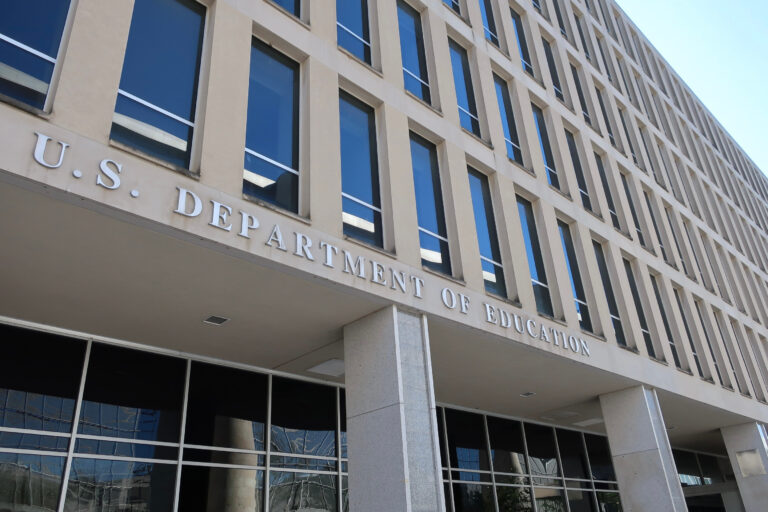
The federal government shutdown, nearing its third week, has curtailed the U.S. Department of Education’s (ED) capacity. ED’s contingency plan for the shutdown reduced staff to 78% of its normal workforce, halting most of the Department’s operations and compounding the effects of the reductions in force (RIF) initiated earlier this year.
Last Friday, the Trump administration announced a new round of RIFs across the executive branch, including 466 employees at ED, according to court filings. ED has not released official details about the RIFs but initial reporting suggests that ED’s Office for Civil Rights (OCR) is among the most affected offices within ED. Other reporting indicates that most of the staff in the Office of Elementary and Secondary Education (OESE) and the Office of Special Education Programs have been terminated, though there has not been any official communication from the Department confirming the scope of the RIFs.
This Wednesday, U.S. District Judge Susan Illston issued an injunction to temporarily prevent the RIFs from taking effect. [The Hill]
Office for Civil Rights (OCR)
The Office for Civil Rights is responsible for monitoring and enforcing federal civil rights laws in education and has faced successive rounds of cuts throughout 2025. Earlier this year, seven of OCR’s 12 regional offices were closed, with many staff positions eliminated.
OCR investigates complaints related to Title VI, Title IX, and Section 504. These investigations directly affect students and families seeking recourse for issues such as discriminatory discipline or failure to provide appropriate accommodations for students with special needs.
Office of Elementary and Secondary Education (OESE)
The Office of Elementary and Secondary Education oversees the core K-12 federal programs under ESEA and discretionary programs. Although Title I funds are the majority of funds disbursed by ED, OESE staff also manage key discretionary programs like comprehensive literacy state development grants.
Despite staff furloughs and layoffs, states can continue to draw down funds that have already been awarded.
Office of Special Education and Rehabilitative Services (OSERS)
The Office of Special Education and Rehabilitative Services—which includes the Office of Special Education Programs (OSEP)—has been reduced to “fewer than a half-dozen employees,” representing a 95% cut since January. [The New York Times, subscription model]
OSEP administers approximately $14 billion annually in formula grants under the Individuals with Disabilities Education Act (IDEA), supporting roughly 10% of the nation’s K–12 students. In addition to funding, OSEP provides technical guidance and oversees state compliance with IDEA’s requirements for Free Appropriate Public Education (FAPE) and Least Restrictive Environment (LRE).
Despite these staffing reductions, the flow of IDEA funds to states and districts remains intact, as disbursements are formula-driven and legally required. However, the cuts could delay technical assistance, compliance reviews, and data reporting, which depend on OSEP personnel to ensure that states and districts meet their obligations under federal law.
Looking Ahead
If upheld, the RIFs could reshape the Department’s structure long-term—consolidating functions, reducing regional presence, and leaving fewer staff available to manage essential oversight. Even if reversed, the uncertainty surrounding ongoing litigation and potential reinstatements is likely to create months of operational disruption.
Although the current shutdown and RIFs are creating operational uncertainty, the flow of formula-based funds should remain stable and the shutdown and RIFs have not immediately affected the flow of previously appropriated grants to K-12 school districts or federal student aid to students at institutions of higher education.