
On Wednesday, the U.S. Department of Education announced Iowa as the first state to receive approval of its ESEA flexibility request in response to the July 2025 “Dear Colleague” letter related to funding and flexibility.
In its official press release, the Department celebrated the approval as a major step toward returning education to the states; however, the waiver granted to Iowa only allows for smaller, state-level tweaks to existing program flexibilities. This does not change how money flows to districts or the purposes and requirements of any federal program. The entire fiscal construct of ESEA (supplement, not supplant, maintenance of effort, school level expenditure transparency, etc.) exists to ensure federal funds support local school districts. What this does allow is for Iowa to streamline state set-aside funding to support those federal programs.
Consider the approval in two categories.
First, state level consolidation. The waiver grants the Iowa Department of Education the authority to consolidate several state level funding streams. In layman’s terms, that means that through FY 2028, Iowa may consolidate reporting and funding for required state level activities in support of Titles II-A, III-A, IV-A, and IV-B of the ESSA, so long as all underlying programmatic responsibilities for each title continue to be met and without changing how funds flow to school districts or the core requirements of federal law.
State-level set-aside funds are the portion of federal grants (5%) that state education agencies retain to run statewide initiatives. In practice, this flexibility allows Iowa to centralize efforts and take a more cohesive statewide approach to supporting districts across areas like professional development (Title II-A), English learners (Title III-A), and student support and enrichment, including 21st Century Community Learning Centers (Title IV).
Second, waiving the requirement that a state agency get ED’s prior approval for certain state-managed waivers. The waiver authorizes the Iowa Department of Education to temporarily waive the following for its districts without ED’s prior approval:
- Title I-A carryover 15% limit more than one every three years (only for FFY 2024 funds). Normally, districts can carry over only a limited share (up to 15%) of their Title I funds from one year to the next, and only once every three years. Under this approval, Iowa may allow districts to carry over more of those funds for one year, giving districts additional time to spend dollars as intended rather than rushing to use them before a deadline.
- Title I-D (neglected and delinquent) transition services reservation limits (through FFY 2028). Districts may reserve a larger share of funds to help students in neglected or delinquent settings successfully transition back into school, supporting continuity of instruction and services.
- Title IV-A (student support and academic enrichment program) flexibility in spending limits. Iowa districts have flexibility in how they allocate these dollars for FFY 2025 beyond the fixed percentages in statute: toward a well-rounded education (at least 20%), safe and healthy students (at least 20%), and effective use of technology (no more than 40%).
- Requirement to get ED approval to grant districts Ed-Flex in subsequent fiscal years without seeking Department approval. The 2019 guidance still applies.
These flexibilities are adjustments to state-level administration and planning, aimed at reducing burden and better aligning funds with statewide priorities. The basic formulas that determine local allocations remain intact, and key fiscal and program safeguards—such as supplement-not-supplant and maintenance of effort—continue to apply in full.
What Was Not Approved
- No LEA block grants. Iowa did not receive approval to convert federal education funds into broad local block grants or to fundamentally restructure how funds flow to districts.
- No broad reporting relief. The state is still required to meet federal reporting and data collection obligations, and ED explicitly requires annual reporting on the use and impact of the waiver.
- No wholesale exemption from ESSA accountability. The waiver does not modify school identification, accountability timelines, or performance expectations.
- ED did not grant open-ended or permanent flexibility. Every element of the approval is time-limited, with clear end dates (ranging from FFY 2024 to FFY 2028), and conditioned on continued compliance with programmatic requirements. The Department also reserves the right to reconsider the waiver if Iowa does not meet the stated terms.
State Waiver Requests
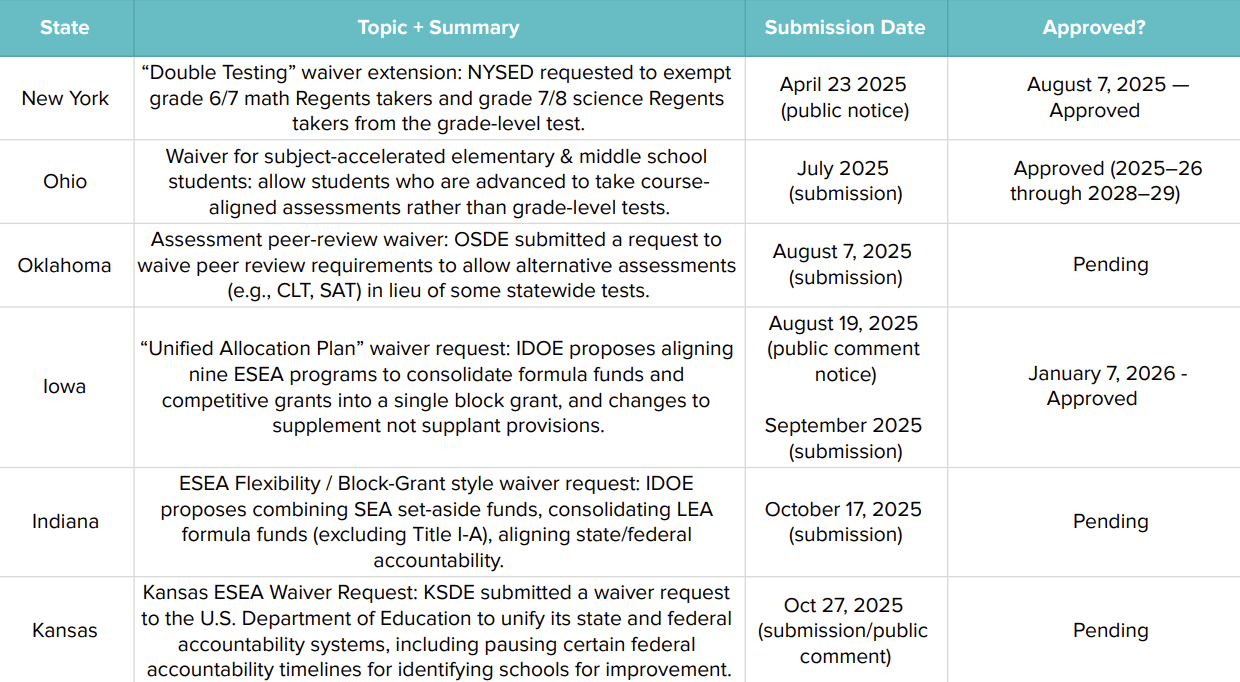
The table below is non-exhaustive and includes waivers that are related to funding, assessment, and accountability. Additional waivers and extensions have been submitted that are not included here.
Stay tuned: Our team will continue to track and monitor state waiver requests and expect to see more to come related to funding, assessment, and accountability. Please reach out to us with any questions.