

I wasn’t allowed to have a Nintendo as a kid.
But some of my fondest memories are of my mother (a lifelong educator) coming home from MECC (IYKYK) conferences with 5.25” floppy disks loaded up with “educational” games.
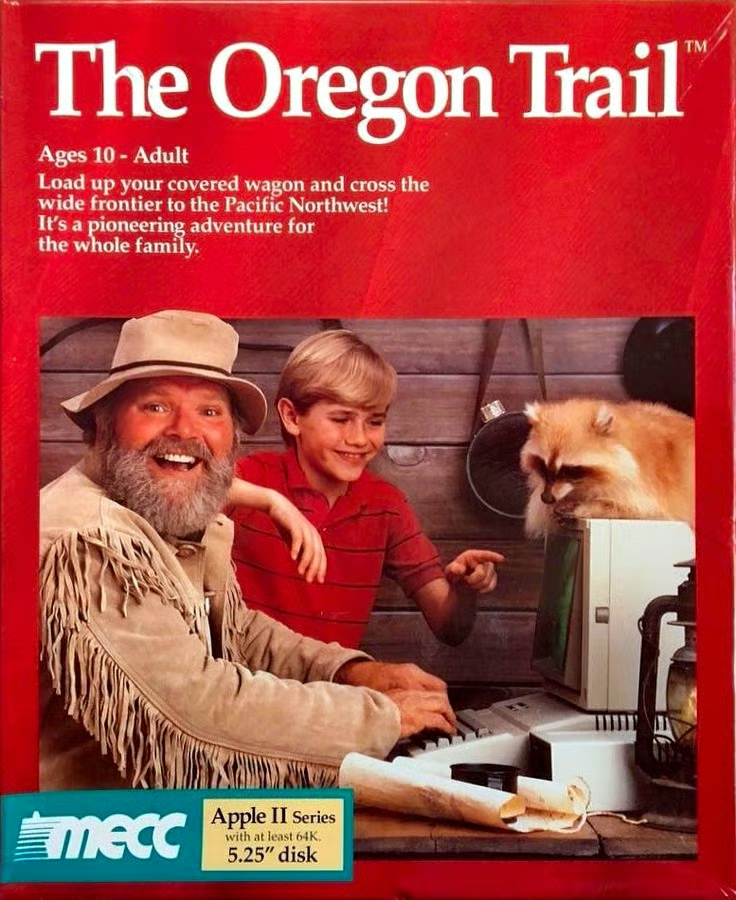
On occasion, my friends would take a break from saving Princess Peach to play Oregon Trail on the Apple IIe that my dad (a middle school teacher) had assembled in our basement.
Even in the 1980s, my parents seemed to distinguish between time spent on the commercial gaming consoles of the day, and educational games developed by organizations like MECC. I’m not sure how educational those games really were, but as a parent of two teenagers, I think they were on to something.
Years later, my mom had mixed feelings when I went to work for the former Xerox CEO and U.S. Deputy Secretary of Education David Kearns who, like me, believed deeply in the transformative potential of technology in education. My mom was no luddite (in fact, she eventually became an edtech director), but like so many educators, she harbored (well-founded, but not always explicit) skepticism of commercial incursion into the field.
Over the years, education’s commercial allergy has at times become intertwined with broader concerns about data privacy and security, screen time, and troubling evidence of the perils faced by young people coming of age in the era of broadband ubiquity and front-facing cameras.
A dialectic view helps make sense of some of the tensions: It’s true that commercial priorities sometimes overshadow educational outcomes, and that interventions are often oversold or under-evaluated. But it’s also true that private-sector innovation has driven—and can drive—meaningful improvement.
There are bad actors on both sides of the procurement processes, but no shortage of principled leaders working to serve students effectively through public-private collaboration in education.
Legitimate parental concerns rooted in children’s well-being are often selectively amplified or weaponized by stakeholders pursuing political or financial ends.
I recently took a walk with a friend who is an extraordinarily successful investor in technologies that will transform the way we learn, work, and live. As a father to young children, he’ll hold out as long as possible before his kids get their first phone. In some circles, that’d make him vulnerable to judgment. But, to me, it’s an entirely rational point of view.
Holding these contradictions together, rather than reducing them to a single narrative, makes for a more honest and productive conversation about how to move forward. That’s not always easy, but there are smart people wrestling with the issue. And there are creative entrepreneurs building technology to help students and schools strike the right balance.
When we fail to acknowledge the dialectic, the debate about the role of technology in education falls prey to reductive arguments and outdated assumptions. It results in the distortion of markets and policy in ways that undermine the potential for step gains in student learning.
I’m no stranger to the risks and often a critic, but still solidly in the camp that—when it comes to education—the risk of slowing experimentation and adoption (of speech recognition technology in early literacy and VR for STEM and mathematics, for example) are largely outweighed by the deleterious effects of the status quo.
That case-making can’t be outsourced to advocacy groups, nonprofits, and charitable foundations. This is work the industry must own—weeding out bad actors, differentiating products, quantifying outcomes and defining norms—to inform how education companies should operate.
If education businesses and investors don’t hold themselves accountable, they should expect confusion and continued concern that the promised transformation is, like the princess, always in another castle.
This article is sourced from Whiteboard Notes, our weekly newsletter of the latest education policy and industry news read by thousands of education leaders, investors, grantmakers, and entrepreneurs. Subscribe here.